info@fmf.co.th
 (+66) 097-034-6625
 LINE it!
Predictive maintenance with AI uses sensor readings, alarms and maintenance history to spot a machine drifting toward failure early enough to plan the repair. It pays off on assets where a breakdown is expensive, where the failure develops over days or weeks rather than seconds, and where someone will act on an alert. The pilot should be judged on unplanned downtime and false alarms per asset, not on model accuracy.
This guide is for plant and maintenance managers who want to know whether predictive maintenance fits their equipment and how to run a first pilot. It goes deeper than the predictive-maintenance section of our guide to AI in manufacturing: choosing the asset, matching sensors to failure modes, setting the alert threshold, and connecting alerts to work orders.
Four maintenance strategies, and where AI fits
| Strategy | When work is done | Works well for | Weakness |
|---|---|---|---|
| Reactive | After it breaks | Cheap, non-critical items with spares on the shelf | Unplanned stops, secondary damage |
| Preventive (time-based) | On a calendar or hour counter | Wear that tracks running time closely | Parts replaced too early, or failures between services |
| Condition-based | When a measured value crosses a fixed limit | Clear single signals: temperature, oil level, filter pressure | Limits set too tight or too loose; misses combined patterns |
| Predictive (AI) | When a model sees a pattern that precedes failure | Critical assets with several signals and a failure that develops over time | Needs data, labels and someone who acts on alerts |
Predictive maintenance does not replace the others. Most plants use all four, asset by asset. AI earns its place where fixed limits either miss the failure or raise too many alarms.
The warning window decides everything
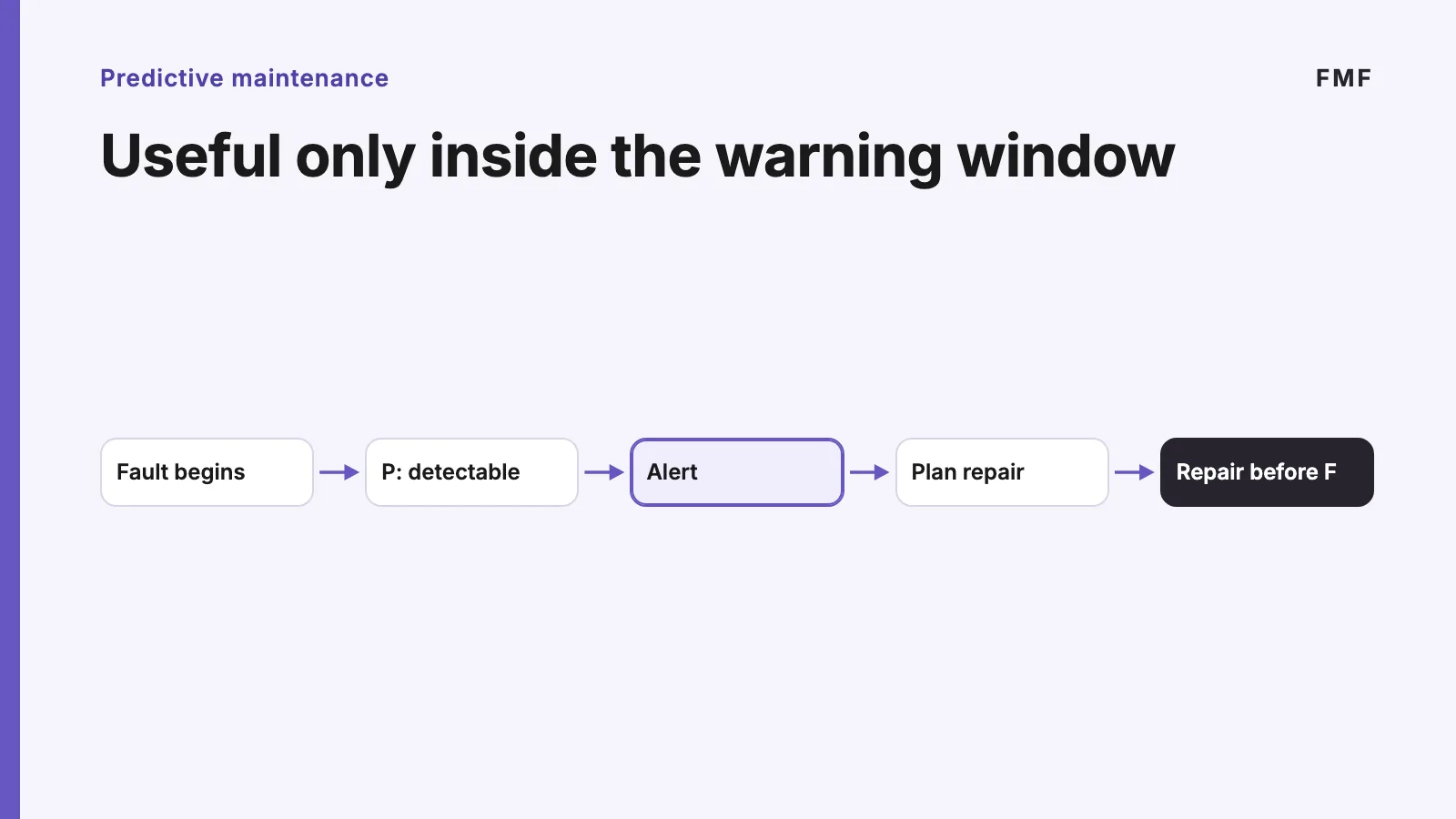
Reliability engineers describe the life of a developing fault with the P-F interval: the time between the point where a fault becomes detectable (P) and the point of functional failure (F). Predictive maintenance only helps if that interval is longer than the time your team needs to plan and carry out the repair.
From detectable fault to failure
An alert is useful only inside the window between detection and the latest safe repair date.
- StartFault beginsBearing wear, misalignment, insulation breakdown
- PDetectableVibration, temperature or current starts to change
- AlertModel flags the assetNames the machine, shows the evidence
- PlanParts, people, planned stopNeeds days, not minutes
- Before FRepair doneFunctional failure avoided
Choose the asset with a simple score
Score each candidate asset from 1 to 3 on five questions and start with the highest total. This is our working checklist, not an industry standard; adapt the weights to your plant.
| Question | 1 | 3 |
|---|---|---|
| Cost of an unplanned stop | Line keeps running | Whole line stops, orders late |
| Failure history | One failure in years | Several recorded failures of the same type |
| Warning window | Fails suddenly | Degrades over days or weeks |
| Signals available | No sensors, no historian | Vibration, temperature, current already recorded |
| Someone will act | No planner or spare parts | Planner, spares and planned stops exist |
An asset that scores 1 on "failure history" is a problem for any learning method: if the machine has failed once in five years, there is almost nothing to learn from. Anomaly detection, which learns normal behaviour and flags departures from it, can still help, but its alerts need an engineer to interpret.
Match sensors to failure modes
| Failure mode | Signals that usually change first | Typical equipment |
|---|---|---|
| Bearing wear, imbalance, misalignment, looseness | Vibration (overall level and frequency spectrum), then temperature | Motors, pumps, fans, spindles, gearboxes |
| Electrical faults in motors | Motor current and its spectrum, winding temperature | Conveyors, compressors, pumps |
| Lubrication problems | Temperature, oil analysis (particles, water, viscosity) | Gearboxes, hydraulics |
| Leaks and blockages | Pressure, flow, cycle time | Hydraulics, pneumatics, compressed air, filters |
| Process-driven wear | Load, cycle counts, quality results by batch | Moulds, dies, cutting tools |
Vibration monitoring has international standards for measurement and evaluation, such as the ISO 20816 series, and ISO 17359 gives general guidance on setting up condition monitoring programmes. Your equipment supplier's recommendations come first; the standards help when you compare measurements across machines.
Set the alert threshold from the cost of a false alarm
Every model trades missed failures against false alarms. The right balance depends on what each costs you, and the maintenance team's patience is a real cost: an asset that raises three false alerts a week will soon be ignored.
Measure the pilot with these numbers per asset: unplanned downtime hours, failures caught with enough warning, failures missed, false alarms, and the time from alert to inspection. Test the model on data in time order, so it never learns from the future, and start with simple thresholds as a baseline that the model must beat.
Connect alerts to work, not to a dashboard
An alert that lands on a screen nobody watches does nothing. The alert should open a work order, or a draft one, in the maintenance system the team already uses, with the machine, the evidence and a suggested check. When the technician closes the work order, the finding (fault confirmed, nothing found, or a different fault) goes back to the model as a label.
That integration is the same kind of work FMF delivers in AI projects. In the KIA Used Cars project, a deep-learning model was connected to the client's back end through a REST API and deployed on a dedicated server for real-time processing, so its output arrived inside the system people used rather than in a separate tool. In the VIN data collection project, data from three external sources was collected in parallel with automatic retries and fed into internal systems and reports. A maintenance alert needs the same reliability: if the connection to the work-order system fails, the alert must be retried, not lost.
A 12-week pilot plan
- Weeks 1–2: choose and baseline. Score the assets, pick one or a small group of identical ones, and record last year's unplanned downtime and failures for them.
- Weeks 2–4: data audit. Check sensor coverage, sampling rates, timestamps and one asset ID across the historian, maintenance and production systems. Add sensors only where a failure mode has no signal.
- Weeks 4–6: baseline rules and first model. Fixed thresholds first, then a model on historical data tested in time order.
- Weeks 6–10: shadow mode. Run on live data without changing how maintenance works. Every alert is checked by an engineer and the result recorded.
- Weeks 10–12: decide. Compare caught failures, false alarms and response time with the baseline. Expand, adjust or stop.
Thai manufacturers planning sensors or data infrastructure for a pilot may be eligible for investment incentives; our AI in manufacturing guide summarises the current BOI and NSTDA programmes.
FAQ
Do we need to buy new sensors?
Not always. Many machines already record temperature, current, pressure or cycle counts in a PLC or historian. A data audit on the chosen asset shows which failure modes have no signal before you spend on hardware.
How much history is enough?
It depends on how often the failure occurs. For a supervised model you want several recorded examples of the same failure type. Without them, start with anomaly detection and engineer review, and collect labels as you go.
Can the model stop a machine automatically?
Do not start there. Automatic shutdown belongs to protection systems designed by controls engineers with deterministic limits. The model should recommend; people and certified safety systems decide.
Which vendor platform should we use?
Equipment makers and industrial software vendors offer monitoring platforms that work well for their own machines. A custom approach makes sense when equipment comes from many suppliers, when the alerts must reach your own maintenance system, or when you want to own the data and the model.
Next step
Score three candidate assets with the table above and note what data each already records. That one page tells us, and you, whether a pilot is ready to start or what is missing first.
Send us your asset shortlist and what each one records today. We will assess whether it is ready for a predictive-maintenance pilot and how we would connect the alerts to your maintenance system.
Assess a predictive-maintenance pilot Chat with us on LINE