info@fmf.co.th
 (+66) 097-034-6625
 LINE it!

A technical SEO audit should tell you three things: whether Google can reach and index the pages that earn you money, what is stopping it where it cannot, and which fixes to make first. The deliverable is a prioritised list of problems with evidence and instructions your developers can act on. A score from an automated tool is not an audit, and neither is a 90-page export nobody reads.
This guide is for business owners and marketing managers who are about to commission an audit, or who have received one and want to know whether it is complete. It covers what the audit is for, what it should check, what you should receive, and how to choose between a free and a full audit.
What a technical SEO audit works through
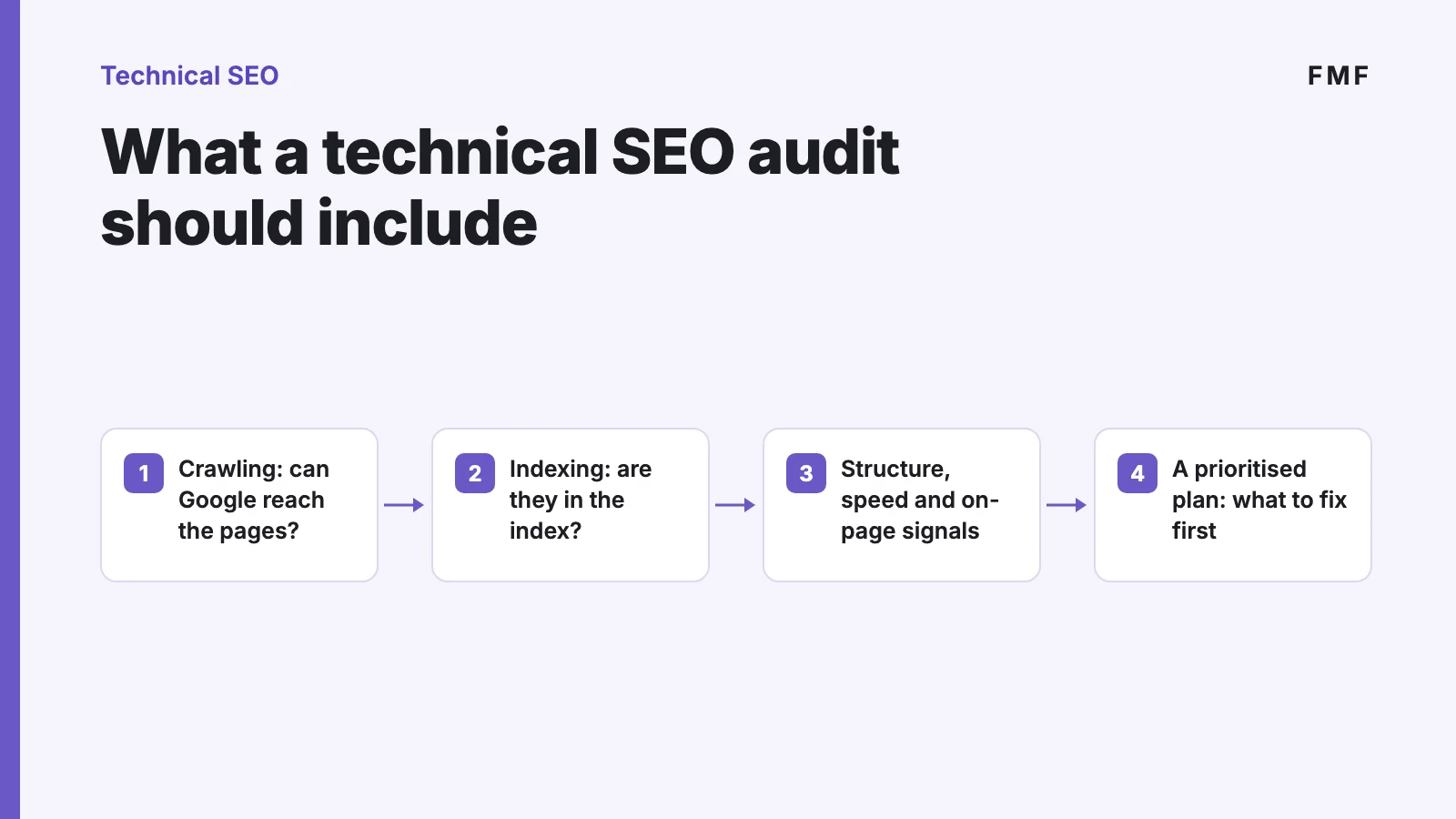
Each stage depends on the one before it: a page that cannot be crawled cannot be indexed, and a page that is not indexed cannot rank.
- 1 · CrawlCan Google reach it?robots.txt, status codes, redirects, sitemap
- 2 · IndexIs it in the index?Canonicals, duplicates, noindex, hreflang
- 3 · StructureCan it be found?Internal links, depth, URL structure
- 4 · PageDoes it load and read well?Speed, mobile, titles, structured data
- 5 · PlanWhat to fix firstImpact, effort, owner
What a technical SEO audit is for
Content and links only work on a website that search engines can read properly. A technical audit checks that foundation. It looks for the faults that keep good pages out of search results or make them compete with each other, and it puts those faults in order of business impact.
It is not a content strategy, a keyword plan or a link-building campaign, though a full SEO audit usually covers those areas as well. If a provider calls a keyword list an “audit”, ask what was checked on the website itself.
When you need one
- Before a redesign or migration, so that the pages that bring traffic today keep their URLs or get correct redirects.
- After a redesign or a change of structure, if search traffic dropped and nobody can say why.
- When pages are poorly indexed, drop out of the index, or the site does not appear for its own services.
- When search traffic has stalled although content is being published regularly.
- Before you sign an SEO retainer, so the monthly work starts from a known list of problems instead of guesses.
What a technical SEO audit should include
The exact checklist depends on the site, but a complete technical audit covers these eight areas. If one is missing from a proposal, ask why.
| Area | What is checked | Why it matters to the business |
|---|---|---|
| Crawling | robots.txt rules, server errors, redirect chains and loops, broken internal links, XML sitemap content | Pages Google cannot reach bring no visitors, however good they are |
| Indexing | Which pages are in the index and which are not, and the reason Search Console gives for each group | Shows whether your service and product pages can appear in search at all |
| Duplicates and canonicals | Several URLs showing the same content, canonical tags, URL parameters, www and trailing-slash variants | Duplicates split ranking signals and can put the wrong URL in the results |
| Site structure | Internal links, click depth of key pages, orphan pages, navigation, URL structure | Important pages buried four clicks deep are treated as unimportant |
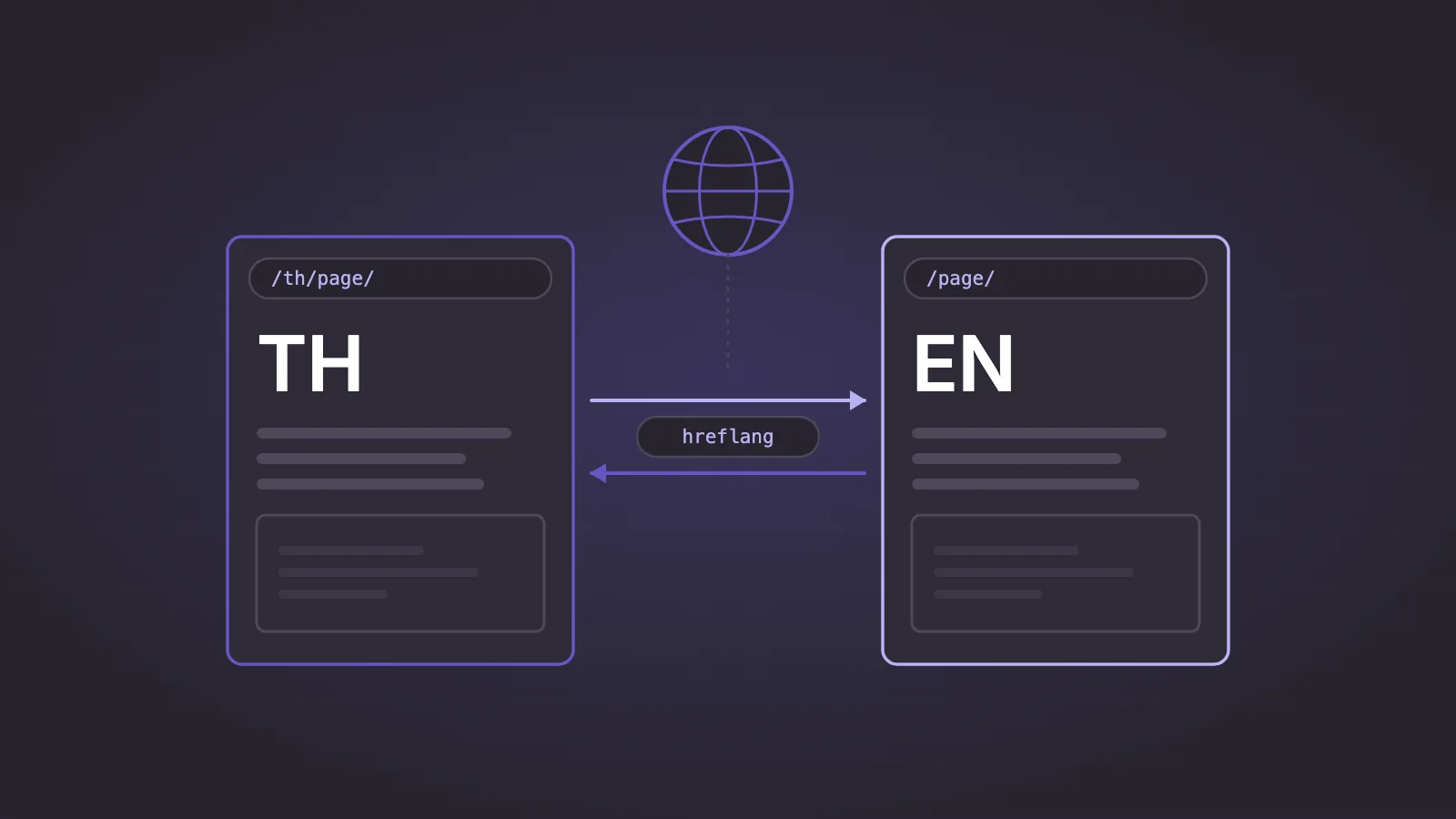
| Languages | hreflang pairs, one URL per language, language of titles and content | On a Thai–English site, the wrong language version in the results loses the click |
| Speed and mobile | Core Web Vitals, image weight, render-blocking scripts, layout on phones | Slow pages lose visitors before the page has finished loading |
| On-page signals | Titles, meta descriptions, heading structure, image alt text, structured data | Decides how the page is understood and how it looks in the results |
| Measurement | Search Console set up and verified, Analytics collecting data correctly, enquiries tracked as conversions | Without it nobody can tell whether a fix worked |
Crawling and indexing come first
Google describes search as three stages: crawling, indexing and serving results (How Google Search works). An audit follows the same order. The auditor compares the pages you want in search with the pages Google has actually indexed, using the Page indexing report in Search Console, and explains every gap.
Good findings in this part are specific. “312 product URLs are excluded as duplicates because the filter parameters create a new URL for every sort order” is a finding. “Improve indexation” is not.
Structure, duplicates and languages
On established business sites, ranking problems are often structural: the same page reachable at several addresses, old URLs redirecting through two or three hops, or key service pages that no other page links to. On bilingual sites, missing or one-way hreflang is the usual addition. Our Thai–English bilingual website SEO checklist goes through those points in detail.
Speed, mobile and page experience
The audit should report Core Web Vitals from real-user data where Google has it, and lab measurements where it does not, and say which templates are slow and why. One recommendation per template is more useful than one per page.
What you should receive
Judge an audit by what your team can do with it the following week.
- A summary for decision-makers: the handful of problems that matter most, in plain language, with what each one costs you.
- A prioritised issue list: each issue with its impact, the effort to fix it, and who should own it.
- Evidence: example URLs, screenshots or exports, so a developer can reproduce the problem.
- Instructions: what to change and what “fixed” looks like, written so the task can go straight into your developers' backlog.
- A baseline: indexed pages, errors and key metrics on the audit date, so progress can be measured afterwards.
An audit that lists two hundred warnings of equal weight has skipped the hardest part of the job. Ask for the order.
What to fix first
- Anything that blocks crawling or indexing of money pages: a wrong robots.txt rule, an accidental noindex, server errors.
- Redirects and duplicates that send visitors or ranking signals to the wrong URL.
- Internal links to key pages and the structure of the main navigation.
- Template-level speed and mobile problems on the pages that receive the most visits.
- Titles, structured data and other on-page details, starting with the pages closest to an enquiry or a sale.
The order can change with the site. A shop with ten thousand filter URLs has a different first task from a ten-page corporate site. The principle stays the same: reach, then index, then quality.
The business value
An audit does not bring traffic by itself. Its value is that the money you spend afterwards goes to the right place. It stops you paying for content on a site Google cannot read properly, gives your developers a short, ordered list instead of a general request to “improve SEO”, and gives you a baseline to hold any agency or in-house team to.
It also protects what you already have. Serious traffic losses often follow a redesign or migration that nobody checked beforehand.
Free audit or full audit
FMF offers the SEO audit in two versions. Start with the free one to see where the site stands. Order the full one when you need the complete analysis and a plan your team can implement.
| Free SEO audit | Full SEO audit | |
|---|---|---|
| Price | Free | From 30,000 ฿, one-time project |
| What it is | An initial assessment of your website | A detailed technical SEO analysis |
| What it covers | The major SEO and technical issues | Indexation, website structure and on-page analysis, plus search visibility and competitor analysis |
| What you receive | Initial recommendations and priorities | A prioritised remediation plan with detailed recommendations for developers and marketers |
| Best for | Deciding whether and where to invest in SEO | A redesign, a migration, a traffic drop, or a site your own team will fix |
The full audit is carried out manually by an SEO specialist and checks more than 160 parameters under FMF's own methodology. Web developers work in the same team, so if you would rather not fix the issues yourself, the fixes can be ordered from us. Both options are described on the SEO audit page, and ongoing technical work is covered under technical SEO.
Questions to ask before you order an audit
- Which areas will be checked, and is the check manual or only an automated crawl?
- Will you use our Search Console and Analytics data, or only external tools?
- How are issues prioritised, and will each one have an example and an instruction?
- Is the report written for developers, for management, or both?
- Is a walkthrough call included, and can our developers ask questions afterwards?
- Who can implement the fixes if our team cannot?
Frequently asked questions
How is a technical SEO audit different from a full SEO audit?
A technical audit covers how search engines crawl, index and render the website. A full SEO audit includes that and adds content, on-page analysis, search visibility and competitors. If rankings are the problem and the site is technically sound, the answer is usually in the wider audit.
Can I run an audit myself with a free tool?
You can run a crawl and get a list of warnings. Search Console is free and shows indexing problems directly. The difficult part is deciding which warnings matter for your site and in what order to fix them, and that is what you pay an auditor for.
How often should a website be audited?
Before and after any redesign, migration or change of platform, and whenever search traffic falls without an obvious cause. Between those events, the Search Console reports are enough to catch most new problems early.
Do we need to give access to the website?
Read access to Search Console and Analytics makes the audit far more accurate, because it shows what Google actually sees. Access to the site's admin panel is normally not needed for the audit itself.
Next step
If you have never had the site checked, start with the free audit: send us the address and tell us which pages matter most to the business. If you are planning a redesign or already know the site has problems, ask for a quote for the full audit.
Send us your website address. We check it and send back the technical issues to fix first. Need the complete analysis? Compare the free and full audit.
Get a free technical SEO audit Chat with us on LINE